
Dr. Masood Tariq
Independent Political Theorist
Karachi, Pakistan
drmasoodtariq@gmail.com
Date: August 14, 2025
——————————————–
Executive Summary
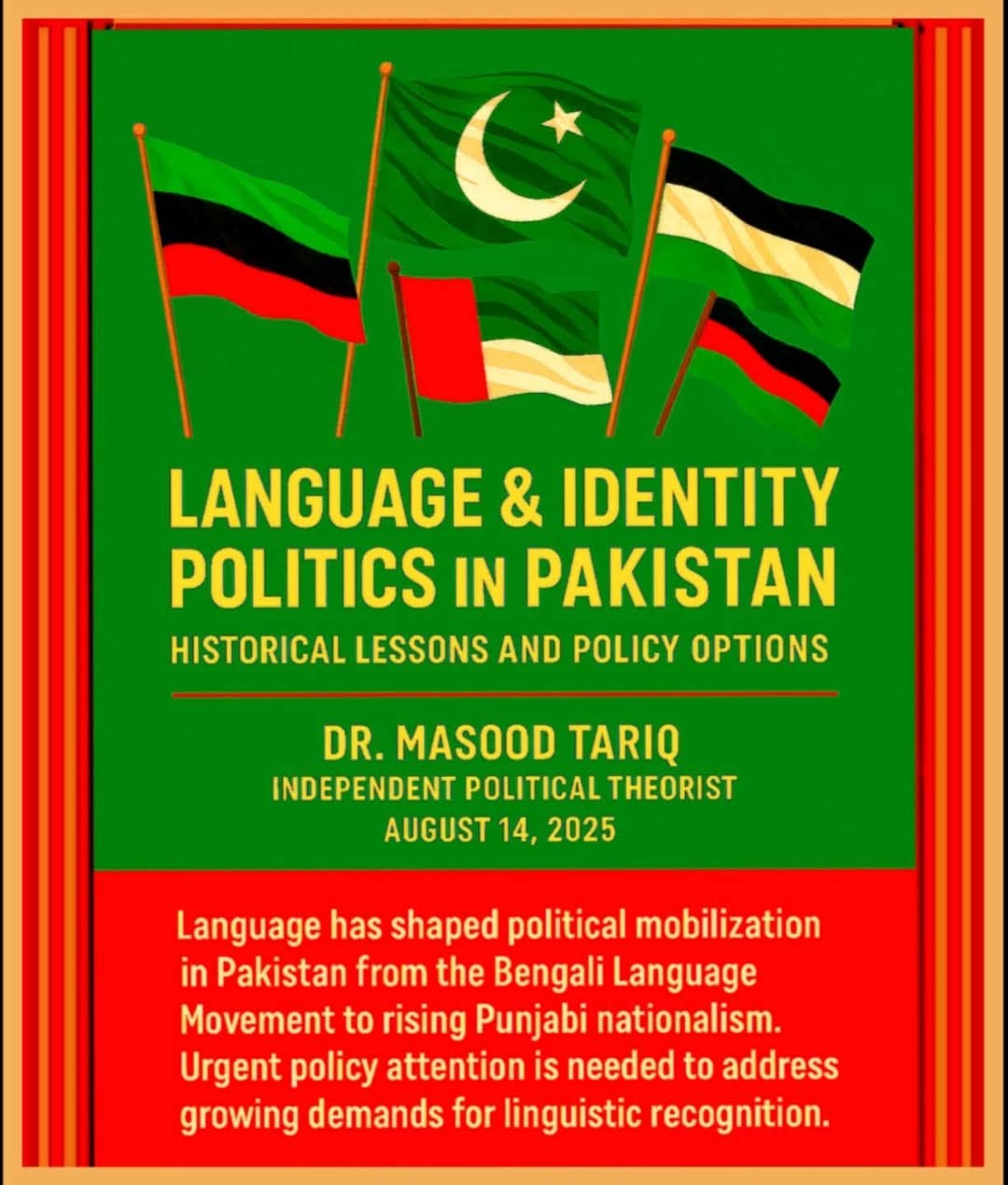
Language has been at the heart of Pakistan’s identity politics since its creation in 1947. From the Bengali Language Movement to the recent rise of Punjabi nationalism, linguistic identities have shaped political mobilization, state formation, and inter-ethnic relations. Mismanagement of linguistic diversity has led to national crises, including the secession of East Pakistan in 1971. Rising demands for linguistic recognition, especially from Punjabi, Sindhi, and Pashto speakers, require urgent policy attention.
This brief traces the historical evolution of language and identity politics, analyzes its political consequences, and offers actionable recommendations to promote inclusivity, national cohesion, and political stability.
——————————————–
Table of Contents
1. Introduction
2. Historical Timeline of Language & Identity Politics
3. Policy Implications of Linguistic Divisions
4. Key Lessons for Policymakers
5. Policy Recommendations
6. Conclusion
——————————————–
1. Introduction
Pakistan is one of the most linguistically diverse countries in the world, with over 70 languages spoken. However, state policy has historically prioritized Urdu—spoken natively by only a small minority—over regional languages such as Punjabi, Sindhi, Pashto, and Balochi. This has often alienated large communities and intensified ethno-political mobilization.
——————————————–
2. Historical Timeline of Language & Identity Politics in Pakistan
Year Event Significance
1948 Urdu declared sole state language by Governor-General Jinnah: Sparked protests in East Bengal, sowing seeds of discontent
1952 Bengali Language Movement peaks; students killed in Dhaka: Martyrdom entrenches Bengali linguistic nationalism
1956 Constitution recognizes both Urdu and Bengali as state languages: First constitutional acknowledgment of multilingualism
1971 Secession of East Pakistan; Bangladesh formed: Linguistic and cultural suppression cited as a key cause
1972 Sindhi Language Bill passed; language riots erupt in Sindh: Signaled Sindhi resistance to linguistic assimilation
1980s Pashto and Balochi language movements gain ground: Linked to ethnic mobilization and regional autonomy demands
2000s Increasing Punjabi cultural revival through literature, music: Grassroots pushback against perceived marginalization of Punjabi
2020s Rising Punjabi nationalism tied to economic and political grievances: Potential for both cultural renaissance and political contestation
——————————————–
3. Policy Implications of Linguistic Divisions
Governance: Centralized language policies have fueled regional alienation and weakened trust in federal institutions.
Security: Language-based grievances have been a mobilizing factor for separatist movements.
Economy: Linguistic marginalization reduces educational outcomes and limits economic integration in rural areas.
Diplomacy: Pakistan’s linguistic diversity can be leveraged for cultural diplomacy in South Asia.
——————————————–
4. Key Lessons for Policymakers
1. Imposition Backfires: Historical attempts to enforce a single language have consistently generated resistance.
2. Recognition Strengthens Unity: Inclusive language policies can foster belonging and reduce secessionist sentiment.
3. Education is a Catalyst: Multilingual education improves literacy, economic mobility, and inter-ethnic understanding.
4. Punjabi Factor Rising: Ignoring Punjabi language rights may turn the country’s largest ethnic group into a source of nationalist mobilization.
5. Media Shapes Narratives: State media’s bias toward Urdu has marginalized regional cultural content.
——————————————–
5. Policy Recommendations
1. Adopt a Multilingual National Policy: Officially recognize major regional languages alongside Urdu.
2. Mother-Tongue Education: Implement regional language instruction in early education for better learning outcomes.
3. Cultural Promotion Grants: Support literature, theater, and media in regional languages to promote pluralism.
4. Decentralized Language Policy: Allow provinces to manage their linguistic affairs within a federal framework.
5. Engage Punjabi Nationalism Constructively: Promote Punjabi culture and language through media and education to channel nationalist sentiment toward unity rather than division.
——————————————–
6. Conclusion
Pakistan’s stability depends on its ability to manage diversity. Historical missteps in language policy have contributed to fragmentation and conflict. Today, as Punjabi nationalism rises and other linguistic identities remain assertive, the state faces both a challenge and an opportunity: embrace pluralism to strengthen national unity.
——————————————–
Author Biography
Dr. Masood Tariq is a Karachi-based politician and political theorist. He formerly served as Senior Vice President of the Pakistan Muslim Students Federation (PMSF) Sindh, Councillor of the Municipal Corporation Hyderabad, Advisor to the Chief Minister of Sindh, and Member of the Sindh Cabinet.
His research explores South Asian geopolitics, postcolonial state formation, regional nationalism, and inter-ethnic politics, with a focus on the Punjabi question and Cold War strategic alignments.
He also writes on Pakistan’s socio-political and economic structures, analysing their structural causes and proposing policy-oriented solutions aligned with historical research and contemporary strategy.
His work aims to bridge historical scholarship and strategic analysis to inform policymaking across South Asia, Central Asia, and the Middle East.
Leave a Reply