
Date: January 2, 2026
Immediately after the 1946 elections in British India, the British government sent a three-ministerial mission to British India to pave the way for the transfer of power to British India.
This mission is known as the “Cabinet Mission” or “Ministerial Mission”. Three ministers were the members of this mission; 1. Lord Pethick Lawrence 2. Sir Stafford Cripps 3. A.V. Alexander. The Viceroy of India Lord Wavell participated in some of the discussions.
The main objective of the mission was to establish a provisional government in British India and to end the constitutional crisis between Congress and the Muslim League to paving the way for the transfer of power.
On reaching British India, the Mission started its discussions with the Viceroy of India, Provincial Governors, Executive Council members, Congress and Muslim League leaders. However, these meetings did not yield any specific results.
Therefore, the mission decided to convene a joint conference of key political leaders at Shimla. This conference was held from May 5, 1946, to May 12, 1946, in Shimla.
Quaid-e-Azam Muhammad Ali Jinnah, Liaqat Ali Khan, Nawab Muhammad Ismail Khan and Sardar Abdul Rab Nishtar participated in this conference on behalf of the All India Muslim League, while the Congress was represented by Abul Kalam Azad, Pandit Jawaharlal Nehru, Wali Bhai Patel and Khan Abdul Ghaffar Khan.
There was a stark difference in the attitude of the two political parties. The Muslim League wanted to divide British India based on Muslims and non-Muslims. While Congress did not agree with the partition of British India.
At the end of the conference, the “Cabinet Mission” or the “Ministerial Mission” was in such a situation that it could neither legitimize the demand of the Muslim League nor the desire of the Congress.
Therefore, the mission presented a plan on 16 May 1946. This plan is called the “Cabinet Mission Plan”. The highlight of this plan was that; It incorporated the viewpoints of both political parties to a certain extent.
The plan had two parts. A short-term plan to establish an interim government. The second long-term plan was to prevent the partition of British India for at least ten years.
The key points of the Cabinet Mission Plan were;
1. An All India Union (central government) consisting of the provinces of British India will be established. This Union will have the departments of Foreign Affairs, Defense, and Communications.
2. The Central Government will form its administration and legislature with the cooperation of the representatives of British India and the States. A majority of the representatives of the two major nationalities and a majority of the members present in the Parliament will be required to decide any matter pending in the Legislature which was likely to give rise to a major communal problem.
3. The plan’s main characteristic was the grouping of provinces. Two groups would be constituted by the mainly Muslim western and eastern provinces. The third group would comprise the mostly Hindu areas in the south and the centre.
According to this plan, all the eleven provinces of British India were divided into the following three groups;
A). In the first group, 6 Hindu majority provinces of UP, CP, Bihar, Orissa, Bombay and Madras were included.
B). In the second group, 3 Muslim-majority provinces of Punjab, Sind, and Northwest Frontier were included in the northwest.
C). In the third group, 2 Muslim-majority provinces of Bengal and Assam were included in the northeast.
4. Apart from foreign affairs, defence and communication sectors, all other sectors were recommended to be given to provinces and states.
5. The constitution of the All India Union and the constitution of each group shall contain a provision whereby any province, if it so desires, shall be empowered to reconsider any point or clause of the constitution after every ten years at the request of a majority of its legislative assembly. According to this clause, all the provinces were empowered to secede from the Union of British India individually or as a group if they so desired after the expiry of ten years.
6. Provinces were asked to allot seats in the provincial assemblies in proportion to their population. One seat was reserved for every million people. The eleven provinces of British India were divided into a total of 292 seats, of which 78 were reserved for Muslims. Similarly, Princely States were given a maximum of 93 seats.
To make the plan workable, the Cabinet Mission also stipulated that any political party rejecting the plan would not be invited to join the interim government.
After reviewing the Cabinet Mission Plan, it is very easy to conclude that; After the Second World War, the British government agreed to grant independence to British India. But there was a difference between the attitude of Congress and the Muslim League.
After World War II, Congress was against the partition of British India. While for the leadership of the Muslim League, no other solution was acceptable without the partition of British India on a Muslim and non-Muslim basis.
Congress approved the Cabinet Mission Plan on June 25, 1946. While the Muslim League refused to approve the Cabinet Mission Plan. Although the main points of the Cabinet Mission Plan were in line with Chaudhry Rahmat Ali’s proposed “Pakistan”.
Chaudhry Rehmat Ali in his pamphlet “Now or never; we live or we will be destroyed forever”?
1. A Muslim country called “Bangistan” was proposed for the Muslims of Bengal.
2. A Muslim country called “Usmanistan” was proposed for the Muslims of Deccan and UP.
3. A country called “Dinas” was proposed for people of different religions in South Asia.
4. A country called “Pakistan” was proposed for the people of five northwestern units of Punjab (without partition), Afghania (FATA), Kashmir, Sindh, and Balochistan.
Whereas the convention of “All India Muslim League” held at Lahore on 23 March 1940 approved “Pakistan” as proposed by Chaudhry Rahmat Ali in Clause No. 2, 3 and 4 as follows;
Clause No. 2.
Resolved that it is the considered view of this Session of the All India Muslim League that no constitutional plan would be workable in this country or acceptable to Muslims unless it is designed on the following basic principle, namely that geographically contiguous units are demarcated into regions which should be so constituted, with such territorial readjustments as may be necessary, that the areas in which the Muslims are numerically in a majority as in the North-Western and Eastern Zones of India, should be grouped to constitute “The Independent States” in which the constituent units shall be autonomous and sovereign.
Clause No. 3.
It has been decided that this is the All India Muslim League’s view that adequate, effective and mandatory safeguards should be specifically provided in the constitution for minorities in these units and these regions for the protection of their religious, cultural, economic, political, administrative and other rights and interests in consultation with them; and in other parts of India where the Mussalmans are in a minority, adequate, effective and mandatory safeguards shall be specially provided in the constitution for them and other minorities for the protection of their religious, cultural, economic, political, administrative and other rights and interests in consultation with them.
Clause No. 4.
This Session further authorizes the Working Committee to frame a scheme of the constitution in accordance with these basic principles, providing for the assumption finally by the respective regions of all powers such as defence, external affairs, communications, customs and such other matters as may be necessary.”
The Muslim League decided on 29th July 1946 as “Direct Action Day” to assert its position of dividing British India into two countries based on Muslims and non-Muslims. 16 August 1946 was also fixed as the date for the strike at the level of the entire British India.
Bengal being the largest Muslim-majority province in British India and Punjab the second-largest Muslim-majority province in British India, the Muslim League paid special attention to Bengal and Punjab to celebrate “Direct Action Day”. For which mosques were also used extensively for meetings, processions and demonstrations.
So on August 16, 1946, terrible riots broke out in Calcutta, the capital of Bengal, and its surroundings. Under the leadership of the leaders of the Muslim League, the Hindu Bengalis were looted and killed by the Muslim Bengalis and about three thousand Hindu Bengalis were killed.
While five thousand Sikh Punjabis were killed in the city of Rawalpindi of Punjab and its surroundings by the systematic planning of the Muslim League. In response to this, Muslim Punjabis were looted and killed in the city of Amritsar in Punjab and its surroundings.
An immortal series of Hindu-Muslim riots began in British India and riots resulted in riots in Calcutta, Bengal. Bombay, Ahmedabad, Navan Kali, and Bihar were also affected. But in Punjab; Rawalpindi, Amritsar and Delhi suffered the most devastation and destruction. While the series of riots continued to increase in the areas of West Punjab.
The Viceroy of India, Lord Wavell, announced on 24 August that Pandit Jawaharlal Nehru and his associates would join the Interim Government after receiving approval from London. Congress took the oath to join the Interim Government on 2 September 1946.
After that, a new series of talks started between the Viceroy of India, Lord Wavell, Quaid-e-Azam and Pandit Nehru to stop the series of Hindu-Muslim riots in British India. As a result, the All India Muslim League announced to join the interim government on 16 October 1946.
On October 25, the Muslim League joined the interim government. The interim government included 6 Congress ministries, 5 Muslim League ministries and 3 minority ministries. There was so much mistrust and disagreement on many issues within this interim government that this interim government failed miserably.
On February 20, 1947, British Prime Minister Lord Attlee announced that by June 1948, power would be transferred to representatives of the subcontinent. The British government recalled the Viceroy of India, Lord Wavell, and sent Lord Mountbatten as the new Viceroy in his place.
Lord Mountbatten arrived in British India on March 22, 1947. On 24 March 1947, Lord Mountbatten was sworn in as the twenty-ninth and last Governor-General of British India. Immediately after taking the oath, Lord Mountbatten began a series of meetings with influential and important political figures in British India.
Commenting on the discussions of the Viceroy with the leaders of British India at this decisive stage, the Sunday Observer, a newspaper published from London, wrote; From these meetings, the Viceroy must have concluded that partition could end the chaos.
After becoming the Viceroy of British India, Lord Mountbatten was well aware that the division of the subcontinent on a Hindu-Muslim basis was now inevitable due to the Hindu-Muslim riots that had been started as a result of the “Direct Action Day”.
After knowing the position of the All India Muslim League and All India Congress, Lord Mountbatten prepared a blueprint of a plan on his part. The creation of two states in British India was the most important objective of this plan.
Lord Mountbatten left for London on 18 May 1947 for further consultation with the British Cabinet and to obtain final approval of his plan. Every aspect of the Mountbatten Plan was thoroughly reviewed in ten days of British Cabinet meetings.
On 28 May 1947, the Viceroy of India’s plan on the issue of British India was finalised. The British government sent Lord Mountbatten to India with more power.
Lord Mountbatten arrived in British India on May 30, 1947, and then on June 3, 1947, Lord Mountbatten announced his plan and said;
1. The subcontinent will be divided into two separate countries, India and Pakistan.
2. These States will initially have dominion status.
3. Punjab and Bengal will be divided into two parts and for this two impartial delimitation commissions will be established.
4. A referendum will be held to take public opinion in North-West Frontier Province and Sylhet.
5. The Provincial Assemblies of Sindh and Assam will decide their future with whom they want to live.
6. The Princely States were empowered to become part of any independent State of their choice.
Lord Mountbatten’s plan was accepted by both the Muslim League and Congress. Hence the British Parliament passed the “Indian Independence Act” on 15 July 1947 and the Queen gave her assent to the “Indian Independence Act” on 18 July 1947.
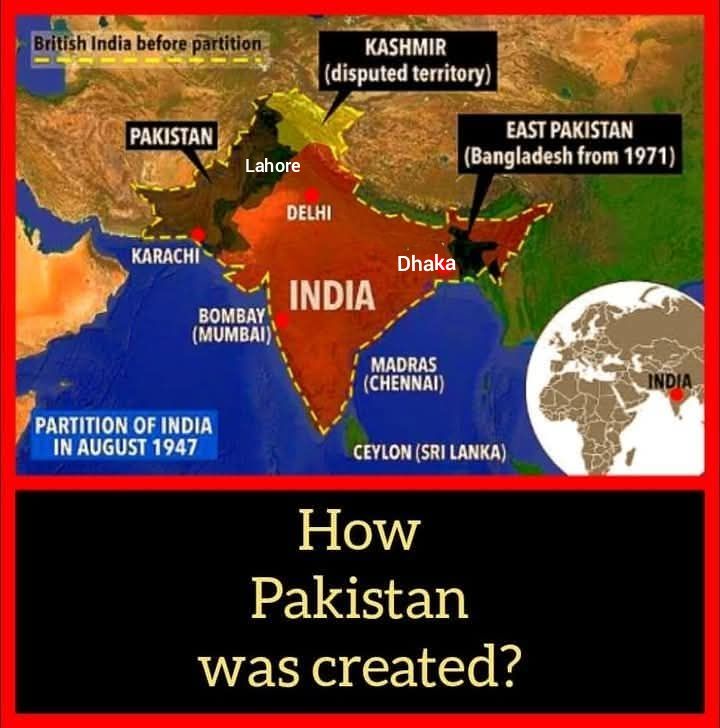
Thus, on 15 August 1947, Pakistan came into existence as a Muslim State consisting of Sindh, Balochistan and the North-West Frontier Province, and on 17 August 1947, Punjab and Bengal were divided and included in Pakistan and India.
Leave a Reply