
According to Article 251 National Language.-(1) Urdu is a national language of Pakistan for official and other purposes. But, due to Article 251 (2), the English language may be used for official purposes until arrangements are made for its replacement by Urdu.
Till today, arrangements have not been made for the replacement of English with Urdu, and it is impossible in the future, too, because Urdu is not the National language of the people of Pakistan. The majority of the people of Pakistan speak Punjabi followed by Sindhi, Pashto, Balochi, etc. Therefore, the national language of the majority of people of Pakistan is Punjabi.
Complete Article: 251 about languages are as under;
251. National language.-(1) The National language of Pakistan is Urdu and arrangements shall be made for its being used for official and other purposes within fifteen years from the commencing day.
(2) Subject to clause (1), the English language may be used for official purposes until arrangements are made for its replacement by Urdu.
(3) Without prejudice to the status of the National Language, a Provincial Assembly may by law prescribe measures for the teaching, promotion, and use of a provincial language in addition to the national language.
The language of Punjab is Punjabi. The language of Sindh is Sindhi. The language of Khyber Pakhtunkhwa is Pashto. The language of Balochistan is Balochi. Therefore, it is not possible to implement Urdu in Punjab, Sindh, Khyber Pakhtunkhwa, and Balochistan.
Under Article (3) Without prejudice to the status of the National Language, a Provincial Assembly may by law prescribe measures for the teaching, promotion, and use of a provincial language in addition to the national language.
Assembly of Sindh, Khyber Pakhtunkhwa, and Balochistan had taken measures for the teaching, promotion, and use of a provincial language in addition to the national language. The Assembly of Punjab is also required to pass the “Punjabi Language Act” for the teaching, promotion, and use of the Punjabi language in addition to the national language.
A vernacular language is used as a native language in a community, but a Lingua-Franca is used beyond the boundaries of its original community and is used as a second language for communication between groups. For example, English is a vernacular in the United Kingdom but is used as a Lingua-Franca in Russian and French to serve a similar purpose as industrial/educational Lingua-Francas in many areas.
Lingua-Franca has developed around the world throughout human history, sometimes for commercial reasons but also for religious, diplomatic and administrative convenience, and as a means of exchanging information between scientists and other scholars of different nationalities.
International auxiliary languages such as Esperanto have not had a great degree of adoption globally so they cannot be described as a global Lingua-Franca.
During the era of the Sikh Empire of Punjab, the native language of Punjabi was the vernacular language and regional Lingua-Franca Persian was the official language of the Sikh Empire of Punjab to exchange information with other nations.
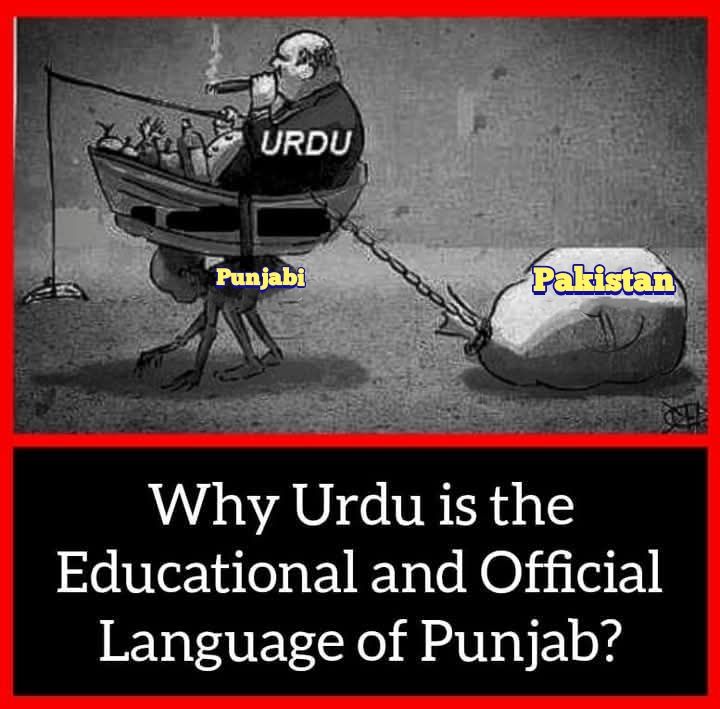
In Pakistan, Punjabi is spoken by 60% of Punjabi as a first language, and 20% of others speak Punjabi as a second language in Pakistan. Why Punjabi is not an educational and official language of Punjab? Urdu is not a Lingua-Franca for international trade and business. Why is Urdu an educational and official language of Punjab?
There is a difference between the national language of any nation and Lingua-Franca for international trade and business. Punjabi is the national language of the Punjabi nation and English is the Lingua-Franca for international trade and business.
Lingua-Franca always takes changes according to the requirements of international trade and business of the nation, but the national language always remains the national language of the nation. In the past, for centuries, Persian was the Lingua-Franca for international trade and business in Punjab, and it was replaced by English.
Neither Urdu is the national language of the Punjabi nation, nor is Urdu a Lingua-Franca for international trade and business; what is the justification for Urdu to be the educational and official language of the Punjabi nation?
Everywhere in the agricultural fields, streets, villages, towns, cities, factories, markets, shops, banks, post offices, courts, police stations, bus stations, railway stations of Punjab, people speak Punjabi. But, the educational and official language of Punjab is not Punjabi, it is Urdu. In Punjab, Punjabi people speak Urdu as their second language due to the status of Urdu as an official national, provincial, and educational language of Punjab.
If any Punjabi speaks Urdu or English in urban areas of Punjab then it does not mean that Punjabi is not able to speak Punjabi. Every Punjabi in urban areas of Punjab also knows to speak one or two languages as a secondary language besides Punjabi, but the primary language of every Punjabi is Punjabi only. If any person does not speak Punjabi as a primary language then he/she will not be considered as Punjabi.
As for the respect for Punjabi language, culture, and tradition, in Punjab, non-educated, agriculture-related and rural residents speak Punjabi, own Punjabi culture and follow Punjabi traditions but some of the elite class, government servants, and urban residents do not have respect, regard, and honour for their motherland language, culture, and traditions due to their environment. Because the basic assembling and vital binding force for Punjab and the Punjabi nation, i.e. the Punjabi language, is not an official and educational language of Punjab.
Punjabis are the largest ethnic population in Pakistan. The great land of five rivers called Punjab is the homeland of the Punjabi nation. Yet, socially and politically, Punjabi is a depressed and deprived nation due to the domination of the Urdu language, the hegemony of Gunga Jumna culture, the supremacy of UP-ite and UP-ite mindset clones of Gunga Jumna culture in policymaking and the decision-making of national affairs and foreign relations of the Punjabi nation from 1849.
Urdu Speaking UP-ite, those concurred foremost cities of Punjab during British rule and after the creation of Pakistan is a major problem for Punjabi Nation and Punjabi Language. As they also speak Punjabi therefore, it is difficult to distinguish whether they are Punjabi or Urdu speaking UP-ite.
By camouflaging in Punjabi skin, the UP-ite, Urdu-speaking Muhajir are the main conspirators in Punjab to confuse Punjabi people and degrade the Punjabi language along with the support to the Urdu language through the propaganda of “Urdu is the Binding Language of Pakistani People”, rather a Language of Muslims which they taught them as a Muslim and being the students of Darul Uloom Nadwatul Ulama, Darul Uloom Deoband, and Barelvi institutions.
Darul Uloom Deoband was founded in 1866, the Darul Uloom Nadwatul Ulama was founded in 1893, and Barelvi schools were established in 1904 in Uttar Pradesh during British Raaj. The medium of teaching in these Darul Ulooms was Urdu. These Darul Ulooms played the conspirator’s role to politicize Islam by propagating the philosophies of these Darul Ulooms as the true teachings of Islam and undermining the languages of Non-Urdu Speaking Muslim peoples by declaring Urdu as the language of Muslims and making Urdu a language of interaction between different Muslim ethnic communities of British India.
The name of the religion of Allah is Islam. Islam aims to correct one’s physical actions, psychic desires and heart thoughts by acquiring knowledge of Islam. So that life of this world and the Hereafter may be improved. The purpose of Islam is not to gain importance, wealth, fame or power by using the name of Islam and manipulating the teachings of Islam.
The Muslim Punjabi, the 3rd largest ethnic community in the Muslim Ummah, the people of the 9th biggest nation of the world and the 3rd biggest nation of South Asia, the followers of Sufi Saints of Punjab became the major victims of the conspiracy of Uttar Pradesh based Darul Ulooms due to, overlapping the promoted true teachings of Islam by the Sufi Saints of Punjab through, introducing the politicized Islamic philosophies of Uttar Pradesh based Darul Ulooms along with encroachment of Punjabi language by the Urdu language.
In the 1800 century, the religious ratio of Punjabi people in Punjab was 52% Muslim Punjabi, 41% Hindu Punjabi, 6% Sikh Punjabi and 1% others, but due to the attraction of the various tribes, castes and the inhabitants of Punjab into a broader common “Punjabi” identity and uniting by the natural affinity of “Punjabi nationalism”, Punjab was a secular regime, Punjabi was a secular nation and a Sikh Punjabi, Maharaja Ranjeet Singh was the ruler of Punjab, after throwing out the Muslim Mughal invaders of Punjab from Delhi, India and Muslim Afghan invaders of Punjab from Kabul, Afghanistan.
Maharaja Ranjeet Singh made Lahore his capital and was able to expand the Kingdom of Punjab to the Khyber Pass and also included Jammu and Kashmir in it. He was also successful in keeping the British from expanding across the River Sutlej for more than 40 years. After he died in 1839, the internecine fighting between the Sikhs and several rapid forfeitures of territory by his sons, along with the intrigues of the Dogras and two Anglo-Sikh wars, eventually led to British control of the Lahore Darbar in 1849.
After Hindi-Urdu Speaking UP, CP people of Gunga Jumna culture, Bengali was the second, and Punjabi was the third biggest nation of South Asia, and for the British, Punjab was a frontier province of British India because Punjab had boundaries with Afghanistan and the Soviet Union. Therefore, to rule South Asia, the prime factor for the British rulers was to control Punjab by dominating or eliminating the Punjabi nation.
British rulers were well aware of the fact that they succeeded in capturing Punjab but not in concurring with the Punjabi nation. Therefore, British rulers imposed martial law in Punjab to govern Punjab and due to fear of Punjabi nationalism; British rulers started to eliminate the Punjabi nation into friction by switching over the characteristics of Muslim Punjabi, Hindu Punjabi, and Sikh Punjabi from the “ Affinity of Nation to Emotions of Religion”.
For demolishing nationalism and promoting religious fundamentalism in Punjab, British rulers, not allowed the Punjabis to use their mother tongue as an educational and official language. Therefore, the British rulers first introduced Urdu as an official language in Punjab and they brought the Urdu Speaking Muslim Mullahs from Uttar Pradesh based Darul Ulooms and Hindi-speaking Hindu Pundits from UP, CP to Punjab for educational teaching of Punjabi people along with, UP, CP bureaucracy and establishment for Punjab administration.
It resulted in the supremacy of UP-ite and UP-ite mindsets in policymaking and decision making in national affairs and foreign relations of the Punjabi nation, managed, motivated and sponsored by the British rulers to eliminate the Muslim, Sikh, Hindu and Christian Punjabi into different religions and languages to secure their rule over the last captured land and martial race of the subcontinent.
As a result, the Punjabi nation became a socially and politically depressed and deprived nation due to the domination of the Urdu-Hindi language, the hegemony of Gunga Jumna culture, and the supremacy of UP-ite traditions.
However, besides all the efforts of British rulers to demolish and eliminate the Punjabi nation, due to the struggle of Punjabi nationalists during British rule in India, besides the dissimilarity of religion, because of natural affinity on the ground of similar language, culture, and tradition, Muslim Punjabi, Hindu Punjabi, Sikh Punjabi, and Christian Punjabi were still a nation. Religion was a personal subject for building moral character and spiritual development in the life of the hereafter. Punjabi nationalism was a subject of worldly life affairs. Whereas, clans moreover, communities were the institutions for social interaction and charity work. Punjab was a secular region, the Punjabi language was respectable, Punjabi culture was an honourable culture and the Punjabi nation was a wealthy nation in British India.
In the 19th century, due to the politics of Congress, dominated by Hindu and Hindi speaking, UP-ite Hindu leaders of UP, CP, and Hindu Punjabi started preferring Hindi language, culture, and traditions instead of Punjabi. Later on, Muslim Punjabi did the same due to the influence of the Muslim League, dominated by the Urdu speaking, UP-ite Muslim leaders of UP, CP, created, prepared, and trained in Aligarh Muslim University established in 1920 and the presence of UP-ite Muslims in Punjab.
As a consequence of preferring the Hindi language, culture, and traditions by Hindu Punjabi and Urdu language, culture and traditions by Muslim Punjabi, the characteristics of assimilation to accomplish the sociological instinct started to switch from “Nation to Religion” and “A Great Nation of Sub-Continent Got Divided and Get Emerged into Muslim and Hindu States” as well as started receiving the reward of hate and regret from every honourable nation, in addition, humiliation, loathing, and abuse from Hindi-Urdu speaking persons too. This is the punishment of Punjabi for not respecting their motherland, language, culture, and traditions. Anyway, Evolution exists everywhere, without realizing that, it is in the right direction or wrong.
Now, for decades, Punjabis are in trouble because of a lack of interest in Punjabi nationalist politics, ignorant of the Punjabi language, unaware of the Punjabi culture, and being uninformed of the Punjabi traditions because of a preference for the Urdu language, Gunga Jumna culture, and UP-ite traditions.
Especially, the Punjabi’s migrated from the Indian side of Punjab to Pakistan were more under the influence of the Urdu language, the domination of Gunga Jumna culture, and the supremacy of UP-ite traditions. Therefore, they accepted and owned the hegemony of the Urdu language, Gunga Jumna culture, and UP-ite traditions by surrendering the Punjabi language, culture, and traditions. In addition, they also facilitated and supported the UP-ite to dominate the Urdu language, Gunga Jumna culture and UP-ite traditions by suppressing and eliminating the languages, cultures, and traditions of actual inhabitants and original entities of Pakistan, i.e. Bengali, Sindhi, Baloch, Pathan and Punjabi (due to many factors).
Hence, the time has proved that; the independence of Pakistan at the cost of splitting up Punjab, the disintegration of the Punjabi nation with the blood of 2 million Punjabi and the displacement of 20 million Punjabis furthermore, lending support to UP-ite for domination of the Urdu language, Gunga Jumna culture, and UP-ite traditions by suppressing and eliminating the languages, cultures, and traditions of actual inhabitants and original entities of Pakistan, in conjunction with, the hegemony of UP-ite Muhajir in national and foreign affairs bureaucracy, military, and civil establishment, skilled and technical professions, politics and media organizations, was a blunder by the Punjabi’s due to political immaturity, irresponsibility, and pettiness.
The Punjabi language was groomed by the Sufi saints. Therefore, the Punjabi language has a spiritual background, and the Punjabi language has the potential for wisdom-related inventions and intellects to develop the moral character for good deeds of life and spiritual development for the life of the hereafter.
For skill-related inventions and intellects, usually, international Lingua-Franca plays an essential role, but for wisdom-related inventions and intellects, spiritually rich language is of vital importance, especially if it is your mother language. Therefore, it is in the best interest of Punjabis to adopt English as an international Lingua-Franca and Punjabi as their national language.
If we start speaking other languages and forget our own, we would not be we, we would be clones of an alien people; we would be aliens to ourselves” UNESCO, 1958.
Punjabi is an actual, original, and potential language of Punjab and the Punjabi nation. A language groomed, patronized, and propagated by the “Sufi Saints of Punjab”. Therefore, it is an earnest need to implant the Punjabi language as an educational and official language of Punjab.
Leave a Reply